

The key strategies behind building a powerful online personal brand
The key strategies behind building a powerful online personal brand
By Luca Dell’oro, ESEI Professor and Tutor (Master in Marketing and Communication).
Personal branding is a serious business. With over 50 percent of the world’s population online in 2018 and more than 2.6 billion social media users, we have a much greater potential to reach new clients, partners and employees online than we did just nine or ten years ago.
Seen as an extension of your reputation, your personal brand is made up of a coalition of your offline activities, social media channels, blogs, websites and professional presence. In your career, a positive personal brand can lead to opportunities, new connections, and more sales.
But don’t make the mistake of thinking your personal brand is what you’re trying to be. In reality, it is what other people currently see you as – and this is an important distinction.
So how can you build and maintain a strong personal brand, boost your presence online and stay true to yourself at the same time?
The fans to detractors ratio
25 years ago, before the internet had taken off and long before we were regularly interacting with people from all over the world, our networks were pretty small. The average professional would probably deal with around 50 or 60 people on a regular basis.
Unfortunately, as it’s impossible to please everybody, even among those few contacts there would be detractors – people who thought you were stupid, incompetent or untrustworthy, for example.
Rather than aiming to get everybody on side, the key was to aim for a positive ratio of fans to detractors. If 80 or 90 percent of your network held a positive or neutral attitude towards you, you were on track for success.
The same holds true today, only our reach is potentially far greater and we are able to interact with many more people, much faster.
The hard thing about managing your reputation
Professionals need to decide whether or not to go for the big numbers on social media, because – as the old saying goes – “the bigger you are, the harder you fall”.
On April 1st this year Elon Musk found this out the hard way. His jokey April Fool’s tweet stated that Tesla had gone bankrupt:
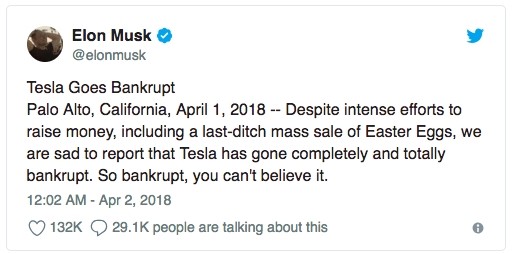
Despite the obvious attempt at humour, Musk’s position as a spokesperson for his company and his personal brand are so intertwined that this tweet caused Tesla’s shares to fall 7 percent – a drop of $3 billion in value.
While not many of us are billionaires with over 20 million followers, it goes to show how important it is to manage what we say and how we say it.
The importance of considering your content
Perhaps the most important aspect of personal brand management to understand is the difference between content and delivery:
– Content is substance. This includes your opinions, ideas and positions you take.
– Delivery, on the other hand, is style. It is simply how you talk and appear online.
Sharing content online can be seen as analogous to painting. If you use two or three strong colours (or opinions) people will understand your position, whether they like it or not.
Yet, if you start to mix the colours – and try to appeal to everyone – you’ll end up with a nasty grey.
Instead of pleasing everyone, you’ll put everyone off because they won’t understand who you are or what you represent.
Unfortunately, it’s easy to make the mistake of “going grey” with your content because most people are afraid to truly be honest and share real opinions, because they know that this can shock part of their audience. While you might be delivering well and presenting your message clearly and professionally, people will stop paying attention to you if your content is a grey mess, with no direction or clarity.
As a case in point, Richard Branson is perhaps one of the best examples of a positive online personal brand. He says what he really thinks and with millions of followers, this means he’ll occasionally create controversy.
For example, his stance on swapping cows for cannabis in New Zealand and suggesting the crop be legalised, grown, tax and regulated, certainly raised a few eyebrows.
Nevertheless, he demonstrates that that no matter how many followers you have, or how many networks you promote yourself on, it’s essential that you present an honest, straightforward version of yourself.
The three steps to building a solid personal brand
When setting out to build a personal online brand, it’s important to think about and determine your objectives.
There are lots of reasons you might want to build a personal brand; it could simply be that you want to be recognised by lots of people and be loved by them, you might want to grow a network of influential people in a local business ecosystem, or you may have a more serious focus on starting an international business or a career.
Once you know why you are acting, it’s time to follow a tried and tested schema:
Step one: Building
To have an impact as a micro-influencer in your niche, you’ll need between 2000 and 5000 followers. So, when you start out, your focus need to be on building a carefully curated followers list.
Do your best to avoid picking up too many inactive users, trolls, and haters. Interact and build a following of active, positive and engaged people in your target market.
Also be sure to connect your content to your objectives, and associate your output with the activities you want to promote in your professional or personal life.
Step two: Optimisation
Once you have a good number of followers on the channels of your choice, you need to pay attention to your data points and start to optimise your account.
Look at certain key performance indicators (KPIs), such as the ratio of inactive to active followers, the number of followers to unfollowers, the number of positive reactions to negative ones when you share content. This will help you not only target active users, but output appealing content that maintains its integrity.
Step three: Screening
Once you have a decent following of engaged fans and have your messaging well defined, it’s time to get closer to your biggest fans.
In order to get a positive return on investment (ROI), your aim should be to start converting fans to clients, otherwise, all your efforts have been in vain.
In summary, it’s key that you deliver the best content you can and invite those who follow you, trust you and like your work to step up and become your clients.

You may also like