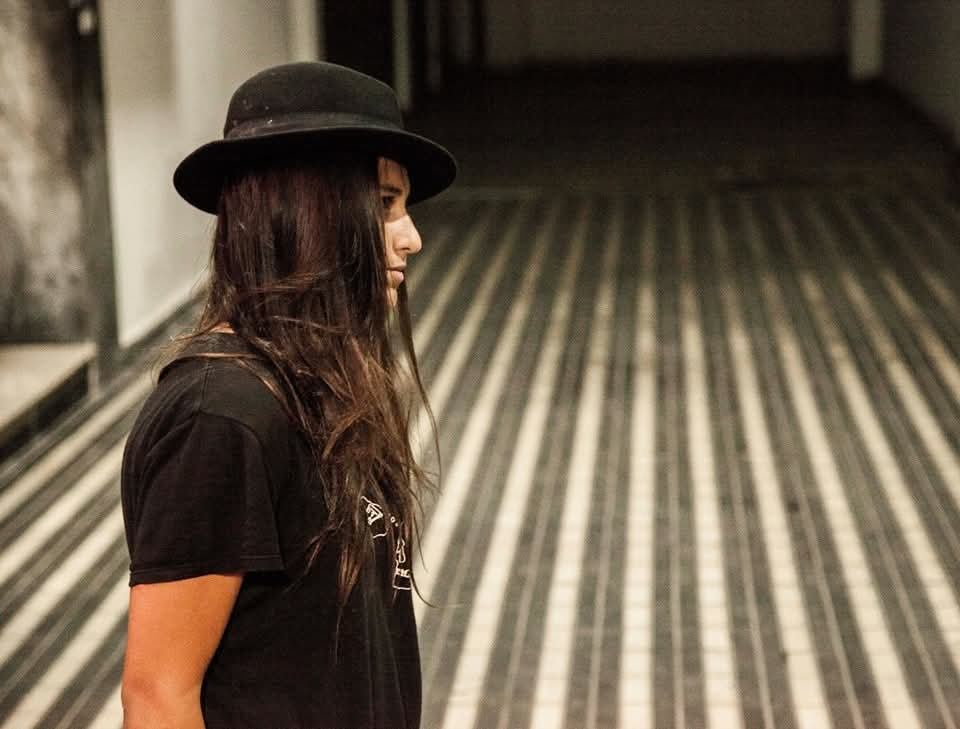
From Beirut to Barcelona: How ESEI Alumna Théa L. Khoury Works at the Intersection of Human Rights
- Posted by Esei
- Date 18 de February de 2026
When Théa L. Khoury arrived in Barcelona to pursue her Master’s in International Relations and International Business at ESEI, she was looking for a programme that combined academic excellence with practical application. Since graduating, she has established herself in the city while managing projects across regions and continents, bridging local activism with global human rights programming.
Originally from Lebanon, Théa’s professional journey began long before her move to Spain. Her early work was rooted in grassroots activism in Beirut, where advocating for women and LGBTQI communities required creativity and discretion. “We did a lot of community led mobilisation focused on women and LBTQ women specifically, also creatives,” she recalls. “We believed a lot in using art as a vessel for advocacy, especially in landscapes such as Lebanon and the broader region, where you cannot really say things very bluntly.”
This combination of creativity, activism, and strategic thinking would later shape her work across Southwest Asia and North Africa, and now on a global scale.
From Theatre to Regional Human Rights Work
héa’s academic background in theatre at the Lebanese American University unexpectedly informed her activist approach. Storytelling and performance became tools for advocacy, enabling her to communicate sensitive messages safely. After graduation, she joined the Arab Foundation for Freedoms and Equality, a regional gender and bodily rights organisation, where she worked on participatory grant making for gender and bodily rights movements across the South West Asian and North African (SWANA) region including Egypt, Sudan, Morocco and Tunisia.
“You can imagine that the context in the region is quite difficult,” she says. “So we had to be very creative in terms of how to move money to activists, into countries where this kind of work is criminalised.”
During this period, Théa also founded Linear Lines, a feminist research and systems thinking collective. The collective continues to operate today across Southwest Asia and North Africa, coordinating projects and consultants on the ground to support community-led organisations with research, monitoring and evaluation, convening, and participatory grant making. “We try to amplify the work of civil society actually working in the region and being an ally to civil society working in other regions adjacent to the global majority. This is really our identity,” she explains.
A Global Role Based in Barcelona
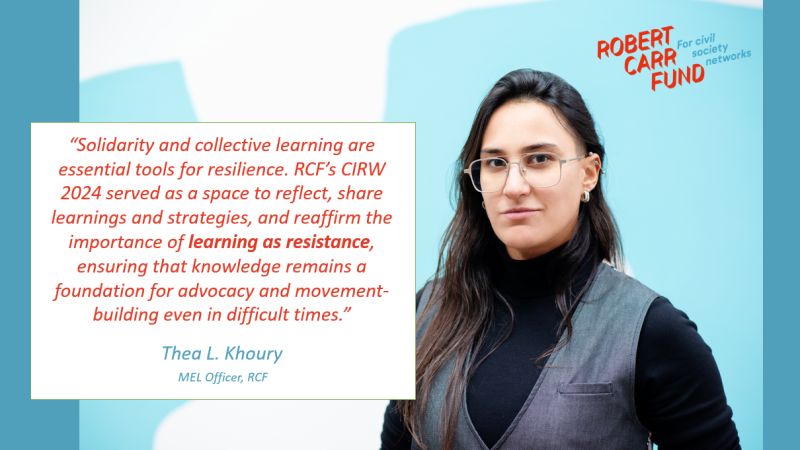
After completing her Master’s at ESEI, Théa took a role with the Robert Carr Fund, an Amsterdam-based organisation providing long-term, flexible core funding to community-led networks working in HIV and human rights worldwide.
Her current role focuses on Monitoring and Evaluation for Learning (MEL). She describes it as highly data-driven but mission-focused: “We receive data from across 72 partner networks globally. I clean the data, synthesise it, analyse it, and we extract insights for donor reporting, annual reporting and evidence based advocacy messaging for more core funding to community-led programming.”
This work is essential in a sector facing significant challenges. Théa highlights the instability of international funding: “The sector is currently falling apart. Funding is very scarce. It has been a very bumpy ride, but we have been adapting and doing what we can to ensure that this kind of life saving programming continues.”
Her role also involves turning raw data into actionable insights for global advocacy. “My work is about creating evidence backed cases for more funding to community-led movements globally. It’s a behind-the-laptop role, but it plays a significant role in ensuring that the movements on the ground get the support they need,” she says.
Théa’s position requires constant adaptation and collaboration across time zones and cultures. “I work with networks from all over the world, coordinating and analysing data while also supporting decision-making that affects how organisations operate in challenging environments,” she explains. She travels to Amsterdam every six to eight weeks for in-person meetings, but much of her work is conducted remotely, bridging the gap between global systems and local impact.
Skills from ESEI That Still Shape Her Work
Although Théa arrived at ESEI with extensive professional experience, she highlights how the project-based programme helped her refine essential soft skills. “Because it is a project based master’s, I learned to be adaptable and to work with different people. I really appreciated that approach,” she says.
Managing group dynamics, understanding people’s strengths, and collaborating across different schedules became key skills she now applies in her daily work. “I felt that was the most valuable skill I got from there. Collaboratively working with people from different backgrounds and varied interests is something I really had to work on,” she explains.
She also valued the discussion-led classes, where professors encouraged dialogue rather than providing fixed answers. “There were a lot of provocations. Professors did not always come in with answers. They wanted us to explore, ask questions and have dialogues. That space for debate and exchange is something I really carry with me.”
The Mindset Needed for International Development
For students aiming for a career in international development, Théa emphasises the importance of purpose. “You just need to have that purpose. My entire career path has been really purpose driven,” she says.
She is also clear about the realities of the sector. “To expect volatility, to expect that it is not a stable sector, and to understand that not engaging means someone somewhere may not get access to a life saving service. You showing up may very well mean that they are.”
Advice for Current ESEI Students
Théa encourages students to make the most of the classroom environment, drawing on its cultural diversity and expert faculty. “Really utilise the classroom space and how many different cultures you have in the room. Approach your professors, ask questions and be present,” she advises. She also encourages a purposeful approach to learning. “Find what you are really interested in and try to walk into the programme already wanting to know more about it, with already something to develop. That is how you make the most value out of these spaces.”
Today, Théa balances her global analytical work with her regional projects through Linear Lines, all while living in Barcelona. Her career demonstrates how education, activism and purpose can align to support communities across borders. For ESEI students aspiring to work in international relations, human rights, or development, her story illustrates the power of combining hands-on experience with thoughtful reflection and a clear sense of purpose.
Explore ESEI’s Programmes
👉 If you’re considering starting your own journey in Barcelona, explore ESEI’s Bachelor’s and Master’s programmes and see how we can support you on your study abroad journey.

January at ESEI: International Programmes, Industry Speakers and Experiential Learning in Barcelona
How to Build a Career in Barcelona as an International Student: Networking Guide 2026
You may also like

How to Open a Bank Account in Spain as an International Student

How to Get Health Insurance in Spain as an International Student